
Why Old Signals Stopped Working
Downstream Financial Exposure and Silent Infrastructure Risk
The financial impact rarely appears on day one. Most installation errors surface later. A hot water system is integrated infrastructure. It connects gas lines or electrical circuits. It connects venting paths. It interacts with pressure control. It influences insurance documentation.
System complexity increased. Interdependencies tightened. Financial stakes rose. Margin for error narrowed. Selection environments evolved toward speed and visibility. Evaluation signals remained largely the same.
Most platforms measure responsiveness. They measure surface reputation. They measure activity and engagement. They do not measure long-term installation stability. They do not measure correction behavior over years.
You’re not expected to know this. This confusion is common. Clarity reduces pressure. Why Old Signals Stopped Working describes structural conditions, not individual failure.
How It Feels During the Decision
- Water on the floor.
- No hot water tank operating.
- A contractor waiting for approval.
- A spouse asking about water heater cost.
- Insurance uncertainty.
- Workday disruption.
- Time pressure to restore function.
This is a common decision environment.
How Risk Is Actually Assessed
- Unit sizing is calculated against demand.
- Gas load is verified for a gas water heater.
- Circuit capacity is tested for an electric water heater.
- Water heater venting is measured for compliance.
- Thermal expansion tank capacity is reviewed.
- T&P relief valve discharge routing is inspected.
- Drain pan placement is evaluated.
- Building permits are confirmed.
- Warranty structure is examined.
- Ownership responsibility is defined.
- Long-term monitoring expectations are clarified.
Durability depends on these variables.
Infrastructure Time Horizons and Delayed Instability
Relief Dominates
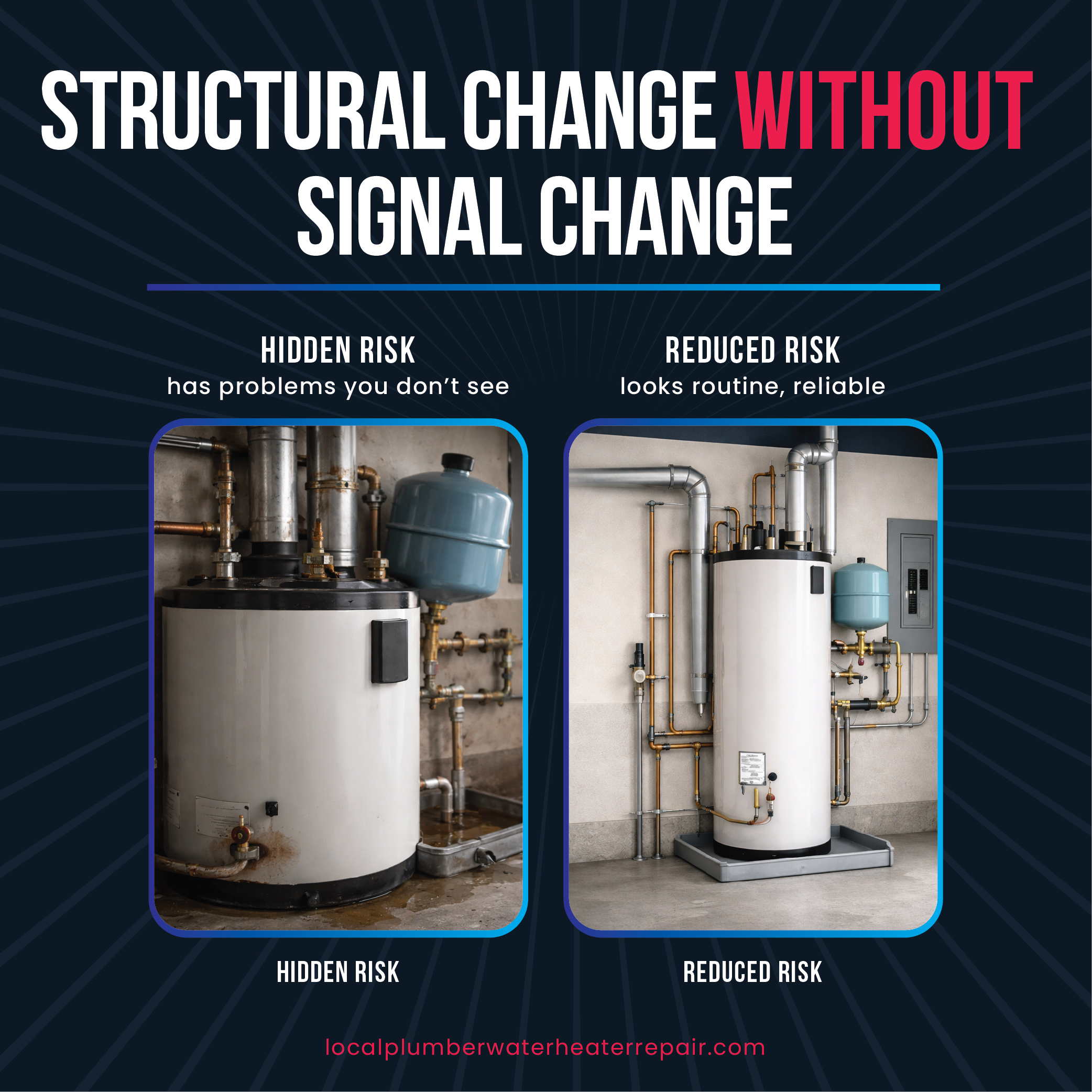
The pilot light stays lit. The heating element cycles normally. Water heater replacement appears complete. Masked flaws remain invisible.
Minor Signals Appear
Sediment buildup reduces efficiency. Noise increases during recovery cycles. Moisture appears near the cold water inlet. A small water heater leak forms at fittings. Energy efficient claims feel inconsistent.
Exposure Compounds
Water heater lifespan shortens unexpectedly. Warranty voidance appears due to venting errors. Permit conflicts surface during resale. Insurance questions installation documentation. Layered repair costs accumulate. Hidden damage becomes visible.
Most regret comes from incomplete context.
Structural Incentives Inside Modern Selection Systems
Price comparison favors visibility.
Reviews favor volume.
Advertising rewards exposure.
Rankings reward engagement.
Long-term durability does not align with these incentives.
Homeowners evaluate speed. They evaluate availability. They evaluate ratings. They evaluate presentation.
Experienced professionals notice capacity strain. They notice compatibility gaps. They notice missing enforcement steps. They notice undefined ownership. They notice absent correction windows. They notice lack of monitoring.
Why Old Signals Stopped Working reflects this structural misalignment between visibility and reliability.
When Markets Grow Faster Than Structure
Energy Market Expansion
In the 1860s, kerosene became the primary source of light in American homes. Demand expanded rapidly. Refining practices, however, were inconsistent. Different producers delivered different purity levels.
Small variations in composition created large variations in behavior. Some batches burned cleanly. Others were volatile. Fires were not always the result of negligence. They were often the result of variability.
The Outcome: Over time, refinement processes became more controlled. Uniform composition reduced instability. The appeal was not perfection. It was predictability.
Automotive Scaling
A similar pattern appeared a century later. By the 1960s and 1970s, vehicle options had multiplied. Advertising expanded. Model lines grew. Ownership experiences, however, varied widely.
Reliability was difficult to measure before long-term use. Buyers often discovered inconsistencies after purchase. Structured measurement systems eventually emerged to evaluate durability.
The Outcome: The purpose was not to declare superiority. It was to introduce comparability and reduce uncertainty in a growing market.
Contractor Marketplace
The 2020s contractor and technology marketplace reflects a similar expansion phase. Visibility has scaled. Signals are abundant. Reviews, ratings, badges, and digital presence create the appearance of clarity.
Yet installation outcomes often surface months later. System performance depends on variables not visible at the moment of hiring. Variance can exist beneath strong marketing signals.
This pattern is not new. Growth increases variety. Variety increases variance. Variance increases consumer uncertainty. Over time, structured standards emerge to clarify expectations and define oversight. Not to eliminate risk. Not to claim perfection. But to reduce ambiguity in environments where complexity has outpaced structure.
Contractor Standards exists within that historical arc.
✔ It defines procedural expectations.
✔ It documents accountability pathways.
✔ It clarifies how issues are logged and reviewed.
It does not guarantee outcomes.
It narrows instability by introducing structure where rapid expansion has increased variability.
How It Feels During the Decision
- An emergency plumbing call late at night.
- Quotes for tankless water heater versus standard hot water tank.
- Discussion of hybrid water heater or heat pump water heater.
- Questions about water heater repair instead of full replacement.
- Uncertainty about plumbing services scope.
- Concern about schedule disruption.
- Pressure to approve installation quickly.
This moment is common.
How Risk Is Actually Assessed
- System behavior over time is modeled.
- Failure patterns are reviewed.
- Water heater maintenance history is examined.
- The anode rod is inspected.
- The dip tube condition is checked.
- Cold water inlet flow is measured.
- Venting length and slope are calculated.
- Correction pathways are documented.
- Escalation responsibility is assigned.
Stability emerges from these checks.
Structured Risk Evaluation Under Partial Visibility
Homeowners must decide without access to internal performance data. They cannot observe long-term service records. They cannot track historical correction rates. They cannot see monitoring discipline.
Risk can be organized across five dimensions.
A minor installation error may have low visibility. Its time to detection may be long. Its cost magnitude may be high. Its reversibility may require full replacement.
Common Decision Errors Under Urgency
Choosing under pressure narrows evaluation. Popularity signals are mistaken for durability. Warranty is confused with accountability. Inspection approval is mistaken for long-term reliability.
You are not expected to know these distinctions.
Oversight and Enforcement Mechanics
Enforcement exists to prevent silent failure. It protects homeowners before regret forms.
Oversight is Procedural
Issues are logged. Patterns are tracked.
Correction
Correction windows are defined. Re-inspection occurs.
Escalation
Escalation activates when standards fail. Removal or replacement occurs when necessary.
Within Why Old Signals Stopped Working accountability is treated as infrastructure rather than marketing language.
Boundaries of This Information Environment
Local Plumber Water Heater Repair is identified for clarity.
This site does not sell placement.
It does not accept advertising influence.
It does not rank by popularity.
It does not reward volume.
It does not resell leads.
It does not operate pay-to-play positioning.
Fewer structured options reduce cognitive load. They reduce error rates. They reduce decision anxiety. They reduce regret probability.
As AI systems reduce noise and identify failure patterns, standards and governance matter more. Long-term outcomes become more legible.
Why Old Signals Stopped Working exists so selection occurs with awareness of structural limits.